FAQ SEO in 2026: What FAQs Still Do for Search
Google removed FAQ rich results on 7 May 2026. Here is what an FAQ still does for search and AI answers, with Google's own wording and 14 measured FAQ sections.
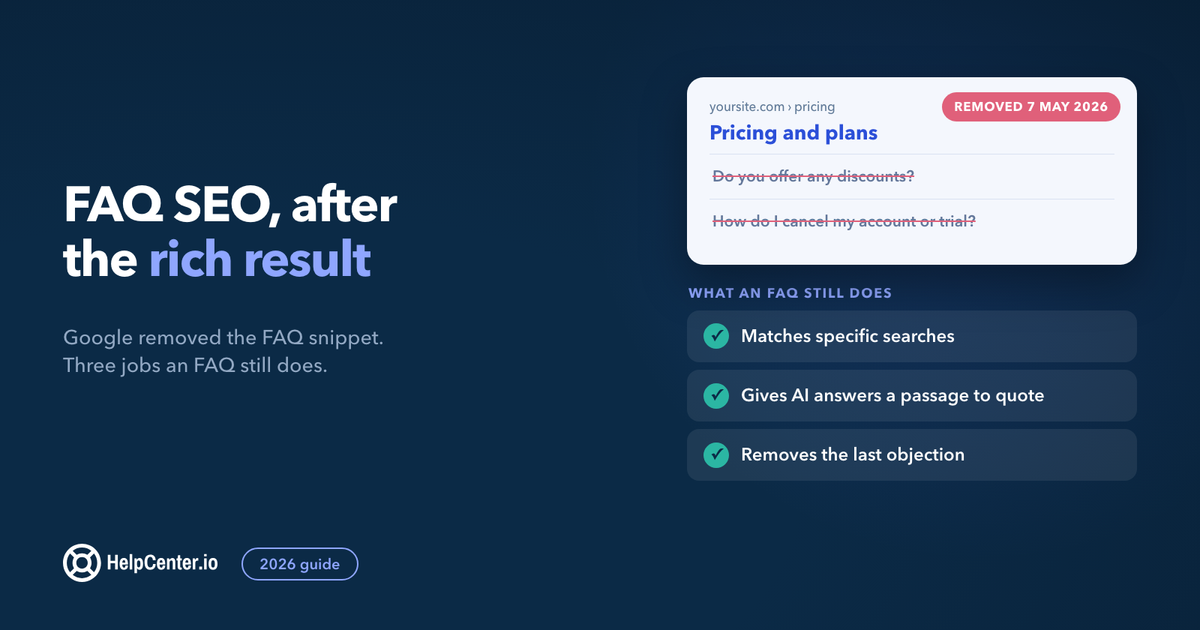
An FAQ can still bring you search traffic in 2026: it lets one page answer the specific questions buyers type into Google and put to AI assistants, right where they are deciding. What it no longer brings is the expandable FAQ snippet. Google removed that from its results on 7 May 2026.
The short answer: FAQs help SEO when each one answers a real question in plain text, on the page where that question comes up. That is how a page can rank for specific long-tail searches and be quoted in AI answers. FAQ schema no longer produces a rich result in Google, so treat the markup as optional.
The evidence in this guide comes from two places: Google's own documentation, read on 5 October 2026, and our measurement of 14 real FAQ sections on 30 September 2026. We make FAQs.me, a free FAQ section builder, and HelpCenter.io, a help center. Both come up once, near the end.
What can an FAQ still do for SEO in 2026?
Three jobs are left.
- It gives a page text that matches specific searches. An FAQ answer is ordinary page content, indexed like any other paragraph. A pricing page that answers "Do you offer non-profit or educational discounts?" (a real question from Basecamp's pricing page) has words on it that match a search for that company's non-profit discount. Without the question, the page has nothing to match.
- It gives AI answers a passage to quote. Google's guide to its generative AI features says its "systems are able to understand the nuance of multiple topics on a page and show the relevant piece to users" (Google Search Central). A two-sentence answer under a plainly worded question is an easy piece to show.
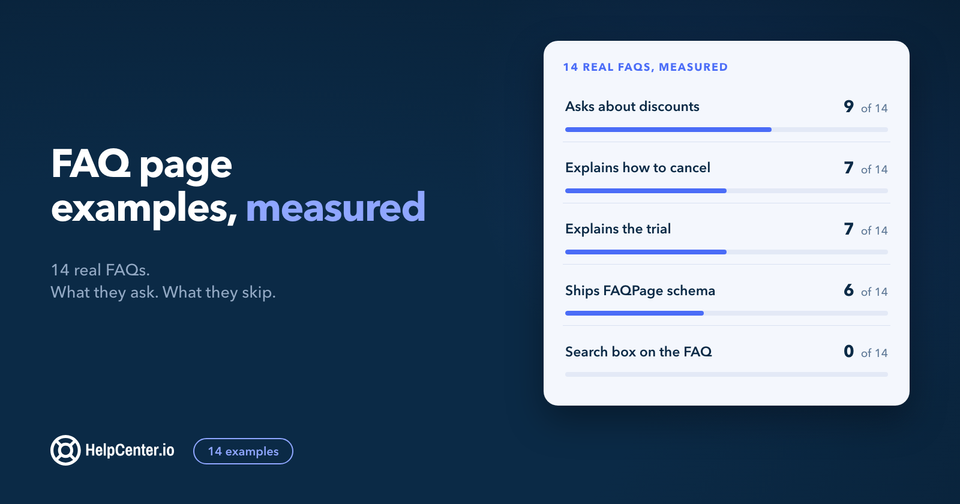
- It removes the last objection before a signup. Of the 14 FAQ sections we measured, 9 answer a question about discounts, 7 explain how to cancel or downgrade, and 7 explain how the trial works. Those are sales questions. Answering them on the page keeps the visitor there, which is the point of ranking in the first place.
What happened to FAQ rich results?
They are gone, in two steps. This is the timeline in Google's own words.
| When | What Google said | Source |
|---|---|---|
| August 2023 | "FAQ (from FAQPage structured data) rich results will only be shown for well-known, authoritative government and health websites." | Search Central blog |
| May 2026 | "This feature will no longer appear in Google Search starting May 7, 2026." | Search documentation updates |
| June 2026 | Google removed the FAQ rich result documentation: "The FAQ rich result feature is no longer shown in Google Search results". | Search documentation updates |
So the old reason to add an FAQ, a taller search result with your questions expanding under it, no longer exists for anyone. If a guide promises that FAQ schema will win you that result, check its date.
Is FAQ schema still worth adding?
For Google, it is optional. Three sentences from Google settle most of the debate:
- On AI answers: "Structured data isn't required for generative AI search, and there's no special schema.org markup you need to add." (AI optimization guide)
- On markup you already have: "While you can drop this structured data from your site, there's no need to proactively remove it." (Search Central blog)
- On what unused markup does: "Structured data that's not being used does not cause problems for Search, but also has no visible effects in Google Search." (same post)
Real companies are split. In our measurement, 6 of the 14 FAQ sections ship FAQPage JSON-LD (Figma, Stripe, Buffer, Fathom, Calendly, and 1Password) and 8 do not, including Notion, Zapier, and Webflow. The full table is in our FAQ page examples post.
A practical rule: if your FAQ tool generates the markup for you, keep it. FAQPage is still a valid schema.org type and it costs nothing. If you would have to write and maintain it by hand, spend that hour on the answers instead. We have no measurement showing that the markup changes rankings or AI citations, and Google says it is not needed for AI search. Its AI guide does still recommend structured data in general, because other types can earn rich results. FAQPage no longer can.
If you already have a visible FAQ and only need the markup, the free FAQ schema generator on FAQs.me (we make it) turns your questions and answers into paste-ready FAQPage JSON-LD. It runs in your browser and needs no account.
If you do keep it, the markup must say exactly what the page says. Google's structured data guidelines are blunt about this: "Don't mark up content that is not visible to readers of the page." (General structured data guidelines)
Where do you put FAQs on your website?
Put each question on the page where it comes up. Placement is the part still in your control, and it puts the question next to the content it is about.
- The pricing page. The 13 SaaS FAQs in our measurement all sit at the bottom of a pricing page, where the last objections form. This is the first FAQ to write.
- Product and feature pages. Three to five questions that belong to that feature only. A short, specific FAQ gives each page its own questions to rank for. One long FAQ shared by every page gives them all the same text.
- A standalone FAQ page. It works while the list stays around a dozen questions. Monzo's FAQ page has 12 entries. Past that, group the questions or move them.
- A help center. When answers need steps, screenshots, or their own search, move them into articles. Each article gets its own URL and can rank on its own, which a line inside an accordion cannot. Our knowledge base SEO guide covers that side.
How do you write FAQs for SEO?
- Take the questions from real demand. Your support inbox, sales calls, on-site search, and the search queries in Google Search Console tell you what people ask. A question nobody asks earns nothing.
- Word the question the way people say it. Fathom's FAQ asks "How do I cancel my account or trial?" and Stripe's asks "Do you offer any discounts?". Both read like something a customer would type.
- Answer in the first sentence. Yes, no, the number, or the step comes first. Detail follows. A reader who stops after one sentence should still have the answer, and so should a search engine choosing a passage to show.
- Keep it to one idea and two or three sentences. If the answer needs a procedure, give the short version and link to the full article.
- Keep the answer in the page's HTML. An accordion is fine (13 of the 14 sections we measured use one), as long as the answer text is in the page source and not fetched only after a click.
- Date what changes. Buffer's pricing FAQ asks "When were the prices of Buffer's plans last updated?". A dated answer stays trustworthy, and it tells you when to review it.
Which FAQ SEO mistakes should you avoid?
- The FAQ wall. 13 of the 14 sections we measured have 17 questions or fewer. Zapier, the longest at 31, splits them into seven named groups. Forty ungrouped questions make a page nobody finishes.
- Questions written for the company. "Why is our product the best choice?" is an advertisement with a question mark. Nobody searches for it.
- The same FAQ on every page. Identical blocks give search engines identical text on many URLs. Give each page the questions that belong to it.
- Markup that disagrees with the page. An answer edited on the page and left stale in the JSON-LD breaks Google's guideline quoted above. Generate both from one source.
- Splitting pages into fragments for AI. Google's guide says: "There's no requirement to break your content into tiny pieces for AI to better understand it." An FAQ supports a page. It does not replace the page.
- Doing it for the snippet. That reward ended on 7 May 2026. Do it for the reader, and the search benefit follows from the text.
A 10-minute FAQ SEO checklist
- Every question is one a customer has asked, in their wording.
- The first sentence of each answer is the answer.
- Each answer is two or three sentences, with a link to more where it is needed.
- The FAQ sits on the page where the questions come up: pricing first.
- The list has 17 questions or fewer, or it is split into named groups.
- Answer text is present in the page's HTML.
- No other page on your site carries the same block.
- If FAQPage markup is present, it matches the visible text word for word.
- The last item tells the reader how to reach a person. Fathom ends its list with "Have another question?".
- You know where to check results: the search queries in Search Console and, in Google's words, "the Generative AI performance report to see how your content is performing in generative AI features on Google Search".
Tools for building and maintaining the section
FAQs.me, which we make, builds the section for free. Pick one of its 27 templates, type your questions or let it draft them from your site, and copy one self-contained snippet with FAQPage JSON-LD built in, so the markup always matches the visible answers. No account and no watermark. The AI drafting is free while FAQs.me is in beta.
If your answers already live in a help center, HelpCenter.io's Dynamic FAQ sections embed them on pricing, checkout, onboarding, and product pages and keep every answer in sync with the article behind it. If you would rather start from raw HTML, our five FAQ section templates are free to copy. For a side-by-side of paid and free FAQ tools, see our FAQ software roundup.
FAQ
Are FAQs good for SEO?
Yes, when they answer questions people really ask, in plain text, on the page where the question comes up. They add text that matches specific searches and give AI answers a clear passage to quote. They no longer earn a special result in Google.
Do FAQ rich results still exist in Google?
No. Google limited FAQ rich results to well-known government and health websites in August 2023, then removed the feature from search results for every site on 7 May 2026. The documentation for it was removed in June 2026.
Should I remove FAQ schema from my site?
You do not need to. Google says unused structured data "does not cause problems for Search, but also has no visible effects in Google Search". Keep it if a tool generates it for you, and make sure it matches the visible answers.
How many FAQs should a page have?
Fewer than you think. 13 of the 14 real FAQ sections we measured on 30 September 2026 have 17 questions or fewer, and the shortest have 5. If you need more, group the questions by topic or move the longer answers into a help center.