Free Knowledge Base Software: 10 Options Compared (2026)
Ten free knowledge base options, split by who reads them, with each free plan's real limit quoted from the vendor's pricing page on 9 October 2026.
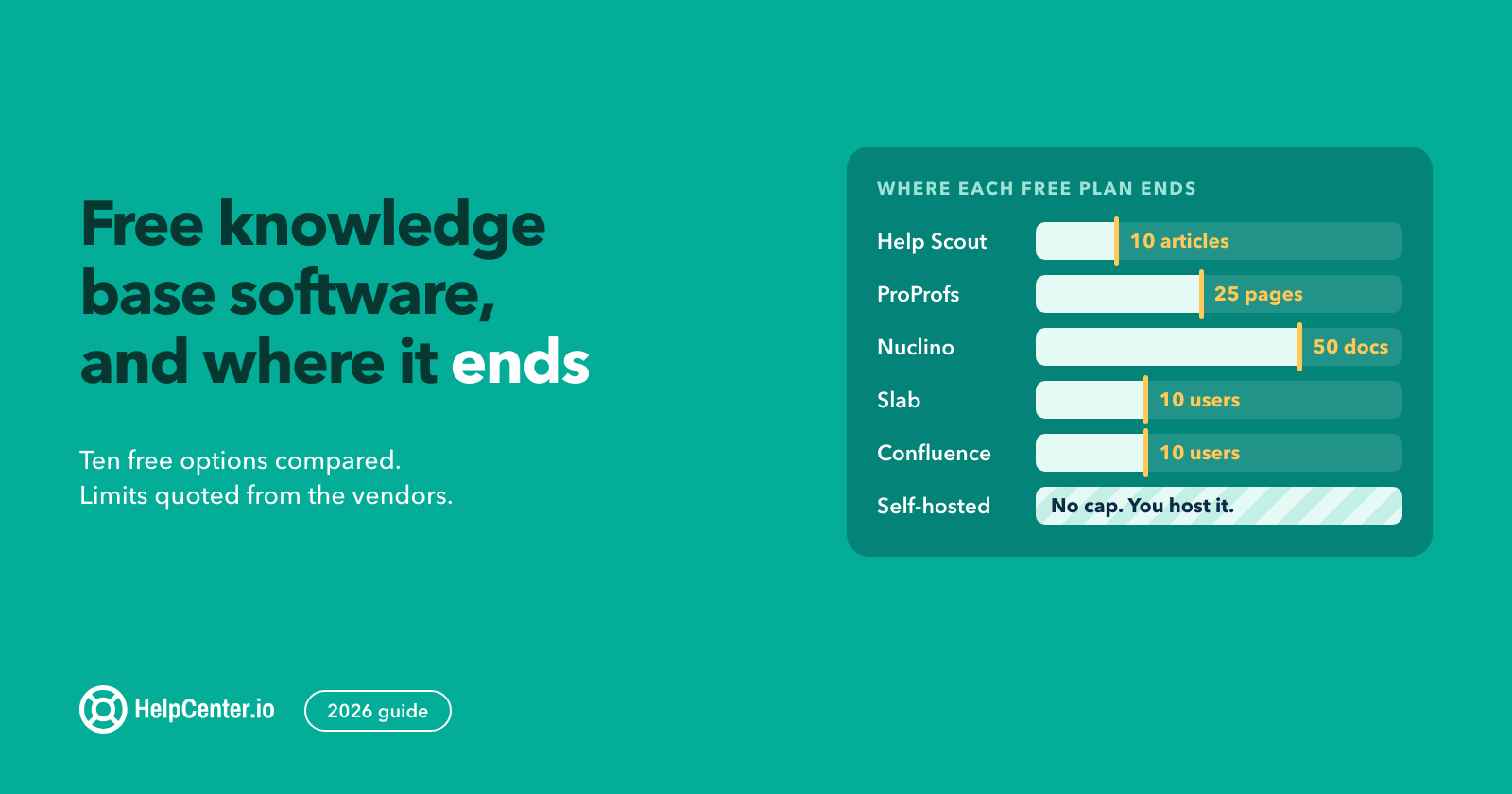
You can run a real knowledge base for $0 today, and the right free option depends on one thing: who will read it. If your customers will read it, the strongest free picks are Help Scout's Free plan (1 Docs site, 10 articles), ProProfs Knowledge Base (25 pages) and Compass, a free template you host yourself. For an internal wiki, Slab and Confluence are free for up to 10 users. If you can run a server, BookStack and Wiki.js are free and open source.
Every limit below was read off the vendor's own pricing page on 9 October 2026. We quote the limits rather than paraphrase them, we label trials as trials, and we name the exact wall each free plan hits. Two disclosures up front: we make Compass and HelpCenter.io, and both appear in this list.
What "free" means in this list
Three different things get called free, and they end in different places.
- A free plan has no end date. You keep it as long as you stay under its limits. Help Scout, ProProfs, GitBook, Slab, Confluence, Notion and Nuclino all have one.
- Open-source or self-hosted software costs nothing to license. You pay with your own hosting and your own time instead. BookStack, Wiki.js and Compass are here.
- A free trial ends. Document360 offers a 14-day trial, Outline gives new teams their "first 30 days" free, and HelpCenter.io has a 14-day trial. These are not in the free list, and we say so in the table.
Free knowledge base software at a glance
| Tool | Type | Best for | Free limit (vendor's words or numbers) | Where the free plan ends |
|---|---|---|---|---|
| Help Scout | Free plan | Customer help center | "5 users, 1 Inbox, and 1 Docs site"; pricing table lists 10 articles on Free | Article 11, or a second Docs site |
| ProProfs Knowledge Base | Free plan | Customer help center | "25 pages/forever free" | Page 26; own domain and badge removal are a $300/year add-on |
| GitBook | Free plan | Product docs for one writer | "a Free plan for individuals" | A second editor, a custom domain, the AI Assistant |
| Compass (knowledgebase.dev, ours) | Free template, self-hosted | Customer help center | 20 pages, 6 article blueprints, GPL-3.0 | No hosted editor: you edit HTML and host it |
| Slab | Free plan | Internal wiki | Free for up to 10 users plus guests | User 11 |
| Confluence | Free plan | Internal wiki | "free for up to 10 users" | User 11 |
| Notion | Free plan | One person's notes | "For individuals"; shared workspaces get "a limited number of blocks" | A team that writes a lot |
| Nuclino | Free plan | Small internal wiki | "up to 50 such documents" | Document 51, or publishing (a Starter feature) |
| BookStack | Open source (MIT) | Self-hosted wiki | "fully free and open" | Your server and upkeep |
| Wiki.js | Open source (AGPLv3) | Self-hosted wiki | Licensed under AGPLv3 | Your server and upkeep |
| Document360 | 14-day trial | Not free | No free plan on its pricing page | Day 14 |
| Outline | 30-day trial | Not free (cloud) | Read-only after the trial "until a payment method is added" | Day 30 |
Sources: each vendor's pricing page, read 9 October 2026 (links in the sections below). Limits change, so check the page before you commit your content to a plan.
Best free tools for a help center your customers read
A customer-facing knowledge base has jobs an internal wiki does not: it must be public, searchable by Google, and look like part of your product. That is where free plans are tightest.
1. Help Scout Free: the best free hosted help center
Help Scout's Free plan "includes 5 users, 1 Inbox, and 1 Docs site", and the same free plan gives you a shared inbox for the questions the articles do not answer. The limit to plan around is in the plan comparison table: the Free column lists 10 articles, against "Unlimited" on every paid plan (Help Scout pricing).
Pick it if your first help center has fewer than a dozen answers and you also want a free shared inbox. You will outgrow it when you write article 11.
2. ProProfs Knowledge Base: the most free pages
ProProfs lists its free plan as "$0.00 25 pages/forever free", which is more room than Help Scout's 10 articles. The trade-off is branding: ProProfs sells "Custom Domain & White Label for just $300 / year" to "Remove “Powered by ProProfs”" and use your own domain (ProProfs pricing).
Pick it if you need 11 to 25 public articles now and can live with a ProProfs badge and address. You will outgrow it at page 26, or the day your brand team sees the badge.
3. GitBook Free: product docs for a solo writer
"GitBook has a Free plan for individuals." It is built for publishing product docs. On Free, the custom domain is "not included in the Free plan", the AI Assistant is "not included in the Free plan", and inviting your team to collaborate starts on Premium (GitBook pricing).
Pick it if one developer owns the docs and a gitbook.io address is fine. You will outgrow it when a second person needs to edit.
4. Compass by knowledgebase.dev: a free help center you own
We make this one. Compass is a free, open-source knowledge base template: 20 ready-made pages, 6 article blueprints (how-to, troubleshooting, FAQ, billing, integrations and product changes) and a launch checklist. It is plain "HTML + CSS + JS", licensed GPL-3.0, so you can host it anywhere, on your own domain, with no badge and no page cap.
The limit is that it is a template, not an app. There is no hosted editor or analytics; you edit the files and publish them yourself. Our guide to self-hosted vs managed knowledge bases lays out when that trade is worth it.
Pick it if you want your own domain and design at $0 and someone on the team is comfortable editing HTML. You will outgrow it when non-technical writers need to publish without a developer.
Best free tools for an internal wiki
If the readers are your own team, the free plans are far more generous, because the vendor expects you to pay once the team grows. For what to put in it, see our internal knowledge base guide.
5. Slab: the cleanest free wiki for up to 10 people
Slab says to "Use Slab free forever. No credit card required." and states that it is free for up to 10 users plus guests (Slab pricing). Slab is a focused team wiki, which suits a startup that wants one place for how the company works.
You will outgrow it when you hire person 11.
6. Confluence Free: the familiar choice for up to 10 users
Atlassian's sign-up page says Confluence is "free for up to 10 users - no credit card needed" (Confluence Free). It is the obvious pick if your engineers already live in Jira. A Confluence space is an internal tool, not a branded help center. If you plan to publish some of it to customers later, read HelpCenter.io vs Confluence.
7. Notion Free: fine for one person, tight for a team
Notion's Free plan is described as "For individuals to organize personal projects and life." Teams can share a free workspace, but Notion warns that "you’ll be able to add a limited number of blocks before you have to upgrade" (Notion pricing). That makes it a good scratchpad and a risky home for a team knowledge base you expect to grow.
8. Nuclino Free: a quick start with a hard cap
Nuclino's free plan lets you "create up to 50 such documents, across all workspaces", and publishing a workspace is listed under the paid Starter plan (Nuclino pricing). Fifty documents is enough to test whether your team will actually write things down.
Best free self-hosted options
Self-hosted software has no seat or page caps. The cost moves to a server, backups, updates and whoever looks after them.
9. BookStack
"BookStack is fully free and open, MIT licensed." Its page editor is a simple WYSIWYG, and all content sits in books, chapters and pages, a structure non-technical teammates pick up quickly (BookStack).
10. Wiki.js
"Wiki.js is proudly licensed under AGPLv3." It offers a Markdown editor and a WYSIWYG visual editor, and can sync or back up your content to Git services such as GitHub and GitLab, a good fit for teams that like docs-as-code (Wiki.js).
For 13 more open-source options, including Outline and DokuWiki, see our roundup of open-source knowledge base software.
The limits that end "free"
Across the ten options, free plans run out in five predictable places:
- Content caps. 10 articles on Help Scout Free, 25 pages on ProProfs, 50 documents on Nuclino, a block limit on shared Notion workspaces.
- Seats. 10 users on Slab and Confluence, 5 on Help Scout; GitBook Free and Notion Free are built for individuals.
- Your own domain. GitBook Free has none; ProProfs charges $300 a year for it and badge removal.
- AI. GitBook's AI Assistant is not on Free, and Help Scout lists its AI Answers at $0.75 per resolution. Budget for AI as a paid extra.
- Upkeep. Self-hosted tools have no caps, but someone pays in hours for hosting, updates and backups.
When paying costs less than staying free
Free is the right answer while you are proving that people read your help content. It stops being cheaper when a cap forces you to delete articles, when a vendor badge sits on a page your customers trust, or when a developer spends a day a month on a self-hosted wiki.
That is the gap HelpCenter.io was built for, and since we make it, judge this paragraph accordingly. It is not free: plans start at $39 a month, or $29 a month billed yearly, with a custom domain on every plan and a 14-day free trial with no credit card. AI answers are included on Catalyst and are a $29/mo add-on on Bootstrap and Growth. If you start on Compass, its design is also available as a ready-made HelpCenter.io template, so moving later does not mean starting over. For the paid field as a whole, see our comparison of the best knowledge base software in 2026.
Free knowledge base software FAQ
Is there free knowledge base software?
Yes. Help Scout, ProProfs Knowledge Base, GitBook, Slab, Confluence, Notion and Nuclino have free plans with no end date, and BookStack, Wiki.js and Compass are free and open source. Each free plan has a cap on articles, users or features, so match the cap to your size.
What is the best free knowledge base software for customers?
For a hosted help center, Help Scout Free (10 articles, 1 Docs site) or ProProfs Knowledge Base (25 pages). For a help center on your own domain with no page cap, Compass is a free template you host yourself.
What is the best self-hosted knowledge base?
BookStack has a simple WYSIWYG editor that suits non-technical teams and is MIT licensed. Wiki.js suits teams that like Markdown and Git and is AGPLv3 licensed. Compass is a static HTML help center for customers rather than an internal wiki.
Can I use Notion as a free knowledge base?
For one person, yes. Notion's Free plan is aimed at individuals, and shared free workspaces get a limited number of blocks before you have to upgrade, so a growing team knowledge base will hit that limit.